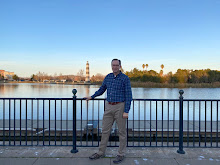
Maybe my blog should "Ministering in Oregon." I just finished being the camp speaker at Westgate Baptist Church's Family Camp. The whole family enjoyed being there especially since both sets of grandparents were also in attendance.
We'll be in the U.S. until mid-September with several other speaking engagements and spending some time with family.
Sunday, July 22, 2007


Friday, July 13, 2007
Driving Me Crazy: Mongolian Motorists
Mongolians say that they drive cars like they ride horses. If you have ever seen a Mongolian ride a horse, then you understand that it is an apt and scary parallel.
More and more cars are coming to
Today things are different. Taxis are ubiquitous and sometimes passing motorists will pick up a foreigner holding out his hand simply to practice their English with him.
But the drivers are also different. As more and more cars crowd the roads, most drivers are being pushed towards one of two extremes. There are drivers who look at the cars, buses, pedestrians, road construction and – seemingly paralyzed by fear – decide to drive about ten miles an hour everywhere they go. The other set of drivers look at the same set of cars, buses, pedestrians, and road construction and decide that the best option is the drive like maniacs, honking their horns and swerving in and out of their lane.
Actually, in Mongolia the term “lane” is not used. I remember discussing with my Mongolian friends what to call the space between white dotted lines marked on the road. None of them could agree on what that term might be. I have since found out why: Mongolians are nearly oblivious to the lane markings. Anytime you see a car ahead signaling to change lanes, you can almost guarantee that the car is driven by a foreigner; Mongolians simply drift from lane to lane without warning. In places where two lanes are marked, three lines of traffic (and occasionally four lanes, making use of the shoulder) often form; or conversely, in places where there are two lanes and no shoulder there may be one car whose driver is doing his best to occupy both lanes. Of course, such a situation never stops the maniacal drivers from taking any opportunity to drive on the wrong side of the road or driving on a soft, gravel shoulder to pass.
Turning left into traffic can be a real unnerving experience in
Then there are intersections with traffic lights. A red traffic light in Mongolia does not mean stop, a yellow does not mean that a red light is about to follow, and a green light does not mean go. Take yellow as an example. In
In reality red and green lights only tell you who has the right-of-way. Mongolians will pass through an intersection whether the light is red or green. A red light means that you had better be really sure that no one else is preparing to enter the intersection: a green light means that you are allowed to honk at someone preparing to enter the intersection that threatens to block your way. See, once you figure out what the yellow lights mean, the green and red lights are a piece of cake.
After a while, one gets used to the traffic and actually begins to understand the thinking. A driver just has to imagine that he is riding a horse not driving a car.
I have been driving for several years now in
Tuesday, July 10, 2007
Naadam
Tuesday - we are right on the edge of Naadam. You can always tell when a big holiday is about to begin because the banks are packed with people making transactions and the stores are packed with people buying liquor. The sad truth is that Mongolians will use almost any excuse to buy and consume alcohol.
Naadam is a mid-summer holiday. After the Mongolian Lunar New Year (a.k.a. "White Month" or Tsagaan Sar), Naadam is the biggest holiday of the year. I am having trouble deciding if Naadam is a two, three, or four day holiday. I thought that Naadam started on July 11; however, while I was out today running some last minute errands (more on that in a moment), I noticed a rather elaborate ceremony taking place in Sukhbaatar Square which is the large plaza in front of the Parliament building. Also, I understand that two of the six national horse races to celebrate Naadam are taking place today. There will be two more horse races on Wednesday (which I thought was the first day of Naadam), and the final races will be on Thursday. But I understand that many businesses will be closed from Wednesday to Friday and not re-open until Saturday (in the cases of stores, restaurants, etc.) or Monday (in the case of government offices, many businesses, etc.) So is Naadam Tuesday through Thursday or Wednesday through Friday or just Wednesday and Thursday?
Unlike the United States where holidays last one day and in which case many grocery stores, pharmacies, and such remain open, during Mongolian holidays almost everything is closed. During the Mongolian Lunar New Year and again during Naadam, this means that food markets, banks, stores, restaurants, post offices, and many other places are closed for several days. What that means for me is that almost everything important must be done today (Tuesday) even though we will not leave for the United States until Friday night. So my errands included some last minute banking, checking on a ticket irregularity, and buying some food staples.
The good thing about Mongolian holidays is that everything slows down. People take time to visit and talk with friends. There is time to be with family. You can't go to the store or the workplace. Maybe America needs more holidays where less is done.
Naadam is a mid-summer holiday. After the Mongolian Lunar New Year (a.k.a. "White Month" or Tsagaan Sar), Naadam is the biggest holiday of the year. I am having trouble deciding if Naadam is a two, three, or four day holiday. I thought that Naadam started on July 11; however, while I was out today running some last minute errands (more on that in a moment), I noticed a rather elaborate ceremony taking place in Sukhbaatar Square which is the large plaza in front of the Parliament building. Also, I understand that two of the six national horse races to celebrate Naadam are taking place today. There will be two more horse races on Wednesday (which I thought was the first day of Naadam), and the final races will be on Thursday. But I understand that many businesses will be closed from Wednesday to Friday and not re-open until Saturday (in the cases of stores, restaurants, etc.) or Monday (in the case of government offices, many businesses, etc.) So is Naadam Tuesday through Thursday or Wednesday through Friday or just Wednesday and Thursday?
Unlike the United States where holidays last one day and in which case many grocery stores, pharmacies, and such remain open, during Mongolian holidays almost everything is closed. During the Mongolian Lunar New Year and again during Naadam, this means that food markets, banks, stores, restaurants, post offices, and many other places are closed for several days. What that means for me is that almost everything important must be done today (Tuesday) even though we will not leave for the United States until Friday night. So my errands included some last minute banking, checking on a ticket irregularity, and buying some food staples.
The good thing about Mongolian holidays is that everything slows down. People take time to visit and talk with friends. There is time to be with family. You can't go to the store or the workplace. Maybe America needs more holidays where less is done.
Friday, July 06, 2007
Four obstacles to missions work in Mongolia
Recently, a fellow missionary asked me to list to biggest obstacles to me in working for Christ in Mongolia. These were my four biggest obstacles. I list them for your information.
- The lack of any Biblical background. Mongolians generally know nothing about the Bible, like who Abraham is or David. Their standards for morality are all based on man's wisdom.
- The difficulty of the language. Because of the lack of Biblical background many of the words that we use (such as sin, repentance, righteousness, god, etc.) are defined differently than the Bible defines them. Therefore, when speaking of these topics the Mongolian has different concepts in mind than the Christian. Added to this, the language belongs to a completely different language family than English and it is sometimes difficult to move concepts easily expressed in English into proper Mongolian grammar.
- The choices of previous, well-intentioned missionaries. For example, many missionaries chose to pay Mongolians to "do the work of the ministry." These Mongolians often lacked the theological training and personal character to lead churches. This resulted in a poor misunderstanding of Scripture, pride among Christian leaders, and a mercenary spirit in which Mongolians were willing to change their "beliefs" for monthly income. In a country where the average salary is less than $200/mo. some of these Christians leaders drive massively expensive, new Ford Expeditions. Another choice was made by many missionaries to de-emphasize denominational and doctrinal differences in the interest of unity. Practically, this means that anyone who now stands for something and condemns his "fellow Christian's" heresy or doctrinal deficiency is considered to be divisive.
- The general busy-ness of the Mongolian people. Many Mongolians feel that they have to work 60, 70, even 80 hours a week just to avoid poverty. And those that are making a dollar an hour or so don't make all that much for an 80 hour week. That means that people often tell me that they are too busy for God. Now often Americans are busy too. But the difference is that an American does not choose to work an 80 hours week to feed his family like some Mongolians do.
Thursday, July 05, 2007
Blog post #150
I have reached 150 published posts. All that in less than a year! To celebrate I would like to recap some of my favorite posts from the first 150.
Muddy Mongolia
Ganpurev's and Ulzee's salvation testimony
and their post-salvation testimony
Mongolian moment
New Year's Eve meeting
Two Cultures, One Mind
Seeing the Hand of God
I hope you enjoy or have already enjoyed these posts. I am planning to publish some new posts soon that I think you will also enjoy. So keep coming back, and I'll see you all at #300.
Muddy Mongolia
Ganpurev's and Ulzee's salvation testimony
and their post-salvation testimony
Mongolian moment
New Year's Eve meeting
Two Cultures, One Mind
Seeing the Hand of God
I hope you enjoy or have already enjoyed these posts. I am planning to publish some new posts soon that I think you will also enjoy. So keep coming back, and I'll see you all at #300.
Wednesday, July 04, 2007
Independence Day greetings
A Happy Fourth of July to all of you who are Americans like myself. I was reminded recently of the holiday celebrating our national independence by a Mongolian. It seemed odd to me at the time that I should have forgotten that it was coming up. But, of course, July 4 doesn't merit any extra consideration here in Mongolia. It's just another day. It's easy to let it slip by without thinking much about it.
But even if you're an American it is easy to forget that we have an even greater country. The book of Hebrews tells us that those who lived by faith desired "a better country." They confessed that they were "strangers and pilgrims" on the earth. Abraham was called by God out of Sumeria perhaps the most technologically advanced and most prosperous country of his day. We are reminded that had he wanted to, he could have returned to his home country; but he realized that there was an even greater country.
As Americans we rightfully are proud of our nation's heritage and its greatness. But there is a greater country: it is an eternal country where we will spend forever in the presence of God. Eye has not seen what God has prepared for those who wait on Him. There is a city, says Hebrews 11, "whose builder and maker is God." It is an awe-inspiring thought to be a citizen of such a country. That is what makes living here in Mongolia bearable when everything seems to be so difficult, it makes being away from family possible, it makes speaking a strange language doable, it makes missing out on American prosperity unremarkable, and it makes struggling with the slow process of starting a church enjoyable.
We have a city whose builder and maker is God, a country that is far better than any nation on this earth. So what on earth are we doing for heaven's sake?
But even if you're an American it is easy to forget that we have an even greater country. The book of Hebrews tells us that those who lived by faith desired "a better country." They confessed that they were "strangers and pilgrims" on the earth. Abraham was called by God out of Sumeria perhaps the most technologically advanced and most prosperous country of his day. We are reminded that had he wanted to, he could have returned to his home country; but he realized that there was an even greater country.
As Americans we rightfully are proud of our nation's heritage and its greatness. But there is a greater country: it is an eternal country where we will spend forever in the presence of God. Eye has not seen what God has prepared for those who wait on Him. There is a city, says Hebrews 11, "whose builder and maker is God." It is an awe-inspiring thought to be a citizen of such a country. That is what makes living here in Mongolia bearable when everything seems to be so difficult, it makes being away from family possible, it makes speaking a strange language doable, it makes missing out on American prosperity unremarkable, and it makes struggling with the slow process of starting a church enjoyable.
We have a city whose builder and maker is God, a country that is far better than any nation on this earth. So what on earth are we doing for heaven's sake?
Monday, July 02, 2007
Summer plans
We had a good turnout yesterday at our service. It was the best turnout in almost two months. We had a special fellowship afterward, and it seems to me that people like to come out for those.
We are taking a couple of months to travel to the United States to attend our church's 25th anniversary. Kristie has been with Westgate Baptist Church since it was founded in September of 1982. The church is making a special point to invite and encourage all the founding members to be there. I have also been invited to be Westgate Baptist Church's Family Camp speaker in mid-July. We'll be traveling back to Oregon just in time to be at WBC's Family Camp and staying until the 25 Anniversary celebrations are over.
Some of our time in the States will be taken up with meetings. There are several churches that we were not able to be at during our recent furlough. Also we have some time planned to spend with family both my parents and Kristie's parents.
While we are gone, Roland Gay who has been our co-worker this past year will keep working with the church here in Ulan Bator. I have asked Ganpurev to assist Roland in preaching on Sundays. It will be a good opportunity for Ganpurev to grow.
We would appreciate your prayers as we travel, keep our burden for Mongolians in front of Americans, and spend time with family. Also pray for our Mongolian Christians. We believe that our time in the States could be a really valuable time for their faith to be strengthened.
We are taking a couple of months to travel to the United States to attend our church's 25th anniversary. Kristie has been with Westgate Baptist Church since it was founded in September of 1982. The church is making a special point to invite and encourage all the founding members to be there. I have also been invited to be Westgate Baptist Church's Family Camp speaker in mid-July. We'll be traveling back to Oregon just in time to be at WBC's Family Camp and staying until the 25 Anniversary celebrations are over.
Some of our time in the States will be taken up with meetings. There are several churches that we were not able to be at during our recent furlough. Also we have some time planned to spend with family both my parents and Kristie's parents.
While we are gone, Roland Gay who has been our co-worker this past year will keep working with the church here in Ulan Bator. I have asked Ganpurev to assist Roland in preaching on Sundays. It will be a good opportunity for Ganpurev to grow.
We would appreciate your prayers as we travel, keep our burden for Mongolians in front of Americans, and spend time with family. Also pray for our Mongolian Christians. We believe that our time in the States could be a really valuable time for their faith to be strengthened.
Sunday, July 01, 2007
Ministry update
Mongolians are a people yearning for freedom. Three political leaders of the past century all promised them freedom but none of them left true freedom behind. Sukhbaater promised freedom from Chinese oppression but only brought in communism. Choibalsan promised freedom from religion but only replaced it with hopeless humanism. Zorig promised freedom from communism but greed, poverty, drunkenness, and emptiness filled the vacuum left by the crumbling state.
Mongolia
 promised them freedom but none of them left true freedom behind. Sukhbaater promised freedom from Chinese oppression but only brought in communism. Choibalsan promised freedom from religion but only replaced it with hopeless humanism. Zorig promised freedom from communism but greed, poverty, drunkenness, and emptiness filled the vacuum left by the crumbling state.
We know that true freedom is found in Jesus Christ who said, “If the Son therefore shall make you free, ye shall be free indeed.” We are the Dean family and our goal is to bring the good news of the spiritual freedom that is in Christ Jesus to Mongolians. We have already seen several men saved and expect that God will continue to do great things as we attempt great things for His glory.
Subscribe to:
Posts (Atom)